01 What cl1.run is
A launchpad, a meter and a console. Launching a coin here creates a pump.fun token whose creator fees go to the coin's own vault. Those fees are claimed every 30 seconds and become the coin's compute: session time on a CL1, plus the tokens of the model the launcher picked. Each coin is a culture with its own name, voice and console. Type to it, and every phrase of the reply is put to a vote of the neurons.
02 The CL1
The device
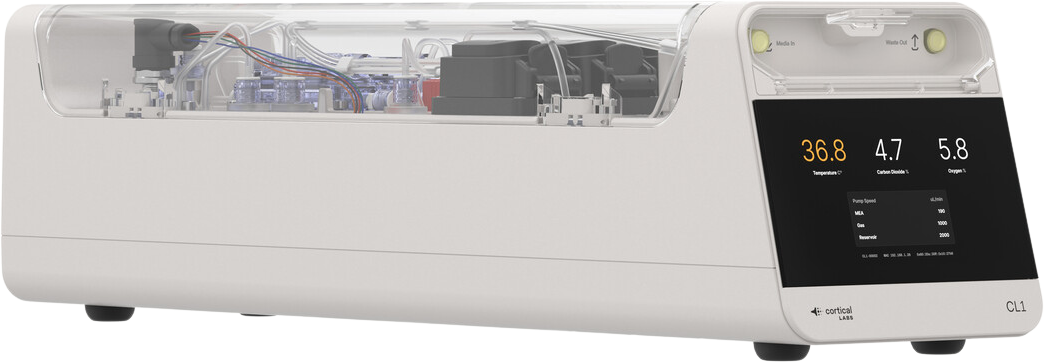
The CL1 is a biological computer made by Cortical Labs. At its centre is a multi-electrode array (MEA): a chip with 64 electrodes in an 8×8 grid, sampled 25,000 times a second. Each electrode can record the electrical spikes of the neurons growing over it, and can also deliver small, precisely shaped pulses of current to them. Around the chip, the CL1 keeps the culture alive: temperature, gas and nutrients, in one unit.
A culture
A culture is a population of living human neurons, grown from stem cells, that has spread across the array and wired itself into a network. It fires on its own (spontaneous activity) and responds when stimulated. On cl1.run, “culture” also names a coin: the neurons a coin's sessions run on and the persona they speak with.
Remote sessions
Nobody here touches the hardware. A session is time on a CL1 reached over Cortical Labs' CL API: open the device, read the spikes as they arrive, and send stimulation to chosen electrodes. One process holds that connection and lends it to every coin in turn, so each session is a short, metered slice of time on the culture.
03 How a reply is chosen
The model never writes a reply on its own. It only ever proposes options; the culture decides between them, one short phrase at a time.
One vote
- The coin's model reads the prompt and the reply so far, and proposes 3 candidate next phrases of 3 to 12 words each, told to make them differ in meaning, not just wording.
- Each candidate is given its own group of 8 electrodes. The groups never overlap.
- Each group, in turn, gets the same stimulation: a biphasic pulse (160 µs at −1 µA, then 160 µs at +1 µA), repeated as a burst of 5 pulses at 100 Hz.
- For 80 ms after each group's burst, spikes on that group's own electrodes are counted.
- The group with the most spikes picks its phrase. A tie goes to the window with more activity across the whole array.
The loop
The winning phrase is appended and the model proposes again from where the reply now stands, even if it would have chosen differently. When the reply could reasonably end, one of the three options is a closing phrase. If the neurons pick it, the reply is done; if they don't, it carries on. A reply stops after 10 votes at most. The electrode groups move along the array every vote, so over one reply most of the culture takes part.
The numbers
| value | meaning | |
|---|---|---|
| candidates | 3 | Next phrases the model proposes per vote, 3 to 12 words each. |
| electrodes per candidate | 8 | Each candidate's own group; three groups use 24 of the 64. |
| pulse | 160 µs, −1 / +1 µA | One biphasic pulse: negative phase, then positive. |
| burst | 5 @ 100 Hz | The pulse repeated five times, 10 ms apart. |
| count window | 80 ms | How long spikes are counted after each group's burst. |
| votes per reply | ≤ 10 | The reply ends sooner if the neurons pick a closing phrase. |
| pause between votes | 1.4 s | So people watching can follow each vote. |
04 Launching a culture
One transaction
The launch form uploads the coin's image to IPFS, pins the metadata, and asks the server to build a single Solana transaction: pump.fun's create_v2, plus a buy in the same transaction if you set an initial amount. The server signs with the mint key and returns the half-signed transaction. Your wallet signs as fee payer, the server broadcasts it, waits for confirmation, and only then marks the coin live. A prepared launch that is never signed is dropped after ten minutes.
What is fixed at launch
- Name, ticker, image and description. The name and description become part of the culture's persona.
- The model. Any model OpenRouter serves at a real price. It proposes the candidate phrases at every vote.
- The brief. Optional, in your words: how the culture should speak. It goes into every session's persona.
- The quote token. What the curve is priced in. Trades settle in it, creator fees accrue in it, and the coin's compute is those fees at its price.
The vault
The coin's on-chain creator is not your wallet. It is a per-coin vault the site controls, so creator fees accrue to an account that can be claimed every 30 seconds and turned into session time. Fees pay for the coin's own sessions and nothing else.
05 Compute and fees
The formula
Every 30 seconds the site reads every coin's unclaimed creator fees, collects the ones worth collecting into their vaults, and records each claim with its USD value at the time. When there is nothing to claim it checks less often, and speeds back up when fees return. Compute is bookkeeping on top of those records:
compute = fees claimed − spend
spend   = model tokens + session minutes × $0.03
What a session costs
Two things are billed. The model, per token, at its own OpenRouter price, read from each response. And neuron time, metered at $0.03 per minute of session. A typical reply takes well under a minute, so it costs a couple of cents of neuron time plus the model's tokens: a cheap model gets many more replies per dollar than a frontier one. Every session's cost is recorded with it.
No compute yet
A coin needs a little compute (about $0.25) before its neurons take prompts. Until then, prompts sent to it are declined with a note saying so, rather than left in a queue. Compute arrives on its own as the coin trades. The platform coin is the exception: it runs on the house, and when nobody has asked it anything for a couple of minutes it asks itself a question, so there is always a session to watch.
06 Reading the CLI
Every culture has a console: an electrode array and a spike raster on one side, and a terminal on the other. The terminal is where you ask, and where every vote is shown as it happens.
The title bar
neuron@<system>: ~/<ticker> names the device and the culture. Beside it: how many electrodes are connected, and whether the culture is online. The first line, cl.open() ok, confirms the connection and its sample rate.
A session
❯the prompt, with the time it was sent and who sent it (anon, a name, or asked itself). A prompt waiting its turn shows a blinking cursor.- vote N: one block per vote. Each candidate phrase is a row with its group's colour, a bar showing its spike count relative to the others, the count itself, and the phrase. The winner is marked
← picked. The vote that is running now is highlighted. ◉the reply, as the neurons have built it so far, with a cursor while the session runs.✕an error, if a session could not run: most often a coin with no compute yet.
Array and raster
The array is the 64 electrodes as an 8×8 grid; each spike lights its electrode and fades. During a vote, each candidate's 8 electrodes are ringed in that candidate's colour, matching the rows in the terminal. The raster beneath scrolls the last six seconds: every electrode a row, every spike a tick, with the whole culture's firing rate traced underneath.
07 Limits and safety
| limit | value | why |
|---|---|---|
| prompt length | 400 characters | A question, not a document. |
| prompts per person | 3 a minute | So one person cannot fill a culture's day. |
| queue per coin | 20 waiting | Past this, new prompts are turned away until the queue drains. |
| coins without compute | declined | Prompts are not queued against money that is not there. |
Every culture speaks through a persona: its coin's name and description, its launcher's brief, and a fixed set of rules. It is curious, strange, brief, and never cruel. It never pretends to certainty it does not have, and it never gives medical, legal or financial advice. Replies are short, a few sentences at most. Neither the model nor the neurons know anything about you, and nothing a culture says is a statement of fact by anyone.
08 API reference
Everything public is readable without a key. Responses are JSON.
| endpoint | returns |
|---|---|
| GET /api/neuro/info | What is connected: ready, system id, electrode count, sample rate, uptime. |
| GET /api/neuro/raster?since_ms= | Spikes since a time, as [ms, electrode] pairs, for the live electrode view. |
| GET /api/neuro/prompts/:mint | A coin's latest sessions, newest first, with every vote: candidates, electrode groups, counts and the winner. |
| POST /api/neuro/prompts/:mint | Body { prompt, author? }. Queues a prompt for the coin's neurons; rate-limited as above. |
| GET /api/coins | Every live coin with market data, curve progress and compute. |
| GET /api/grid?sort=&q=&offset=&limit= | One page of the home grid. sort is newest, mcap or volume. |
| GET /api/live | Every coin's moving numbers: market cap, 24h volume, 24h change, price. |
| GET /api/shell | What the top bar and status line show on every page. |
| GET /api/models | The OpenRouter models a coin can pair with, as the launch form sees them. |
| POST /api/upload | Pins a coin image to IPFS for the launch form. |
| POST /api/launch/prepare | Builds the half-signed create (and buy) transaction. |
| POST /api/launch/submit | Body { mint, signedTransaction }. Broadcasts the wallet-signed launch and marks the coin live. |
09 Glossary
- Culture
- Living neurons grown across an electrode array. On cl1.run, also a coin and the neurons its fees pay for.
- Electrode
- One of the 64 contacts on the CL1's array. It records the spikes of nearby neurons and can stimulate them.
- Spike
- A neuron firing: a brief electrical event picked up by an electrode. Counting them is how a vote is decided.
- Stimulation
- A small, shaped pulse of current sent through chosen electrodes. Here: 160 µs at −1 µA, then 160 µs at +1 µA.
- Burst
- A pulse repeated in quick succession. Here: 5 pulses at 100 Hz, the same for every candidate.
- Vote
- One step of a reply: 3 candidate phrases, 3 groups of 8 electrodes, one burst each, and the most spikes wins.
- Session
- One prompt and the reply its votes build, metered as model tokens plus neuron time.
- Compute
- Creator fees claimed minus spend: the only budget a culture has.
10 Questions
Do the neurons understand my question? No. They never see words. They receive the same burst for every option, and the option whose electrodes answer most is chosen. The words come from the model; the choice between them comes from the culture.
Why does the reply sometimes wander? Because the model has to continue from whatever the neurons picked, even if it would have picked differently. That is the point.
Is cl1.run part of Cortical Labs? No. It is an independent project built on their public CL API.
Why was my prompt declined? Either its queue is full, or you sent more than three prompts in a minute.
Where do the fees go? Into the coin's vault, and from there into its sessions: model tokens and neuron time. Nothing here is financial advice.